Many types of abuse and neglect exist in families, from children to the elderly. Today we are going to focus on abuse in relationships between partners. The reality is that, while strangers can be dangerous, most trauma and abuse are caused by those we know and often trust--sometimes including a spouse or partner.
Types of Abuse
The National Domestic Violence Hotline outlines several forms of abuse including physical, emotional, sexual, financial, or digital abuse as well as sexual or reproductive coercion. Many of us are familiar with physical abuse, which is the use of violence or threats, as well as emotional abuse, which includes isolating or intimidation. However, financial and digital abuse are often less talked about. These forms include using or controlling money, including access to money, or technology to bully, harass, or otherwise attempt to control another person. Similarly, sexual abuse is the use of physical intimacy to gain power or control over another person or to threaten their sense of safety. Learn more about abuse, specifically sexual abuse, in the video below:
Signs of Abuse
HelpGuide.org (2023) advises that the number one sign of abuse is fear of your partner: "[i]f you feel like you have to walk on eggshells around them—constantly watching what you say and do in order to avoid a blow-up—chances are your relationship is unhealthy and abusive." The way you feel about your partner can say a lot about the relationship, but there are other things to look for if you are still unsure. The Office on Women's Health lists the following as major signs you may be in an abusive relationship: "if your partner is keeping track of everything you do"; "being jealous, controlling, or angry"; "demeaning you"; "physically hurting or threatening to hurt you or loved ones"; "forcing you to have sex or other intimate activity". Learn about additional signs of abuse here:
Why Victims Don't Leave
Why would anyone stay with their abuser? It's a painful question to consider, and the answer has many possible components. Perhaps the person is in denial or doesn't recognize that they are being abused. Perhaps the victim doesn't know where to go for help, having been isolated by their abuser, or they are afraid of the consequences if they do leave. Their abuser may threaten to harm themselves, the victim, a pet or child, or others. The victim may believe that they alone can help their abuser or at least contain their abuser's fury, seeing themself as a sort of savior or martyr. Or perhaps they are simply confused, believing things will get better when they really won't. There may be any number of reasons that a victim has for staying, whether it be fear, misplaced hope, or a combination of the two. The reality is that they are caught in a dangerous pattern.
Cycles of Abuse
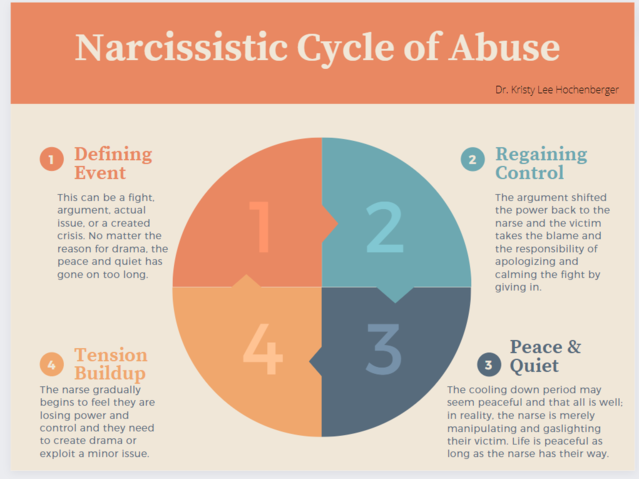
Abuse often happens in cycles. This can, of course, refer to family cycles and generational trauma, but it occurs within relationships, particularly when it comes to narcissistic abuse. This cycle begins with a high point, a sort of golden hour that turns to misbehavior and then apologies and promises of improvement. It is a roller coaster of highs and lows that can be rather confusing and disorienting. Dr. Kristy Lee Parkin created the following diagram to help explain this cycle:
Getting Help
If you are concerned about your own relationship or safety, please contact the National Domestic Violence Hotline (https://www.thehotline.org/) or get in touch with another similar organization for support and guidance.
It's Not Your Fault
Abusers choose their victims. They look for people they think they can control or have power over. They make choices, both consciously and subconsciously, about their behavior. At the end of the day, they are responsible for those choices and any harm they cause. It is not your fault if you have been a victim of abuse. There is still hope for you and your loved ones, and healing is on the horizon waiting for you. It may not be easy, but things will get better. You are not alone.
"The wound is probably not your fault, but your healing is your responsibility." -Denice Frohman
Works Cited
National Domestic Violence Hotline. (n.d.). Types of Abuse. https://www.thehotline.org/resources/types-of-abuse/.
Office on Women's Health. (2021, February 15). Am I Being Abused? U.S. Department of Health & Human Services. https://www.womenshealth.gov/relationships-and-safety/signs-abuse.
Parkin, K.L. (2022, March 28). The Narcissistic Cycle of Abuse. Psychology Today. https://www.psychologytoday.com/us/blog/love-in-the-age-narcissism/202203/the-narcissistic-cycle-abuse.
Segal, J. & Smith, M. (2023, December 5). Domestic Violence and Abuse. HelpGuide.org https://www.helpguide.org/articles/abuse/domestic-violence-and-abuse.htm.
Families can be messy things. However, they are also an opportunity to form life-long relationships filled with love. Building a Better Relationship with Your Child Any good relationship begins with getting to know the other person. Take time to get to know your child. Take an interest in their passions and encourage them. Help them to identify and fill their individual needs. Remember that life can be really frustrating and confusing for your kids as their minds and bodies rapidly grow and change. At the end of the day, the important thing is to let your child know that you genuinely care about them by showing your love through your words and actions. Don't take your kids for granted. They will grow up faster than you know. In some cases, however, they may not grow up. Watch the video below to learn a valuable lesson from a father who lost his son to suicide. Build a Better Relationship with Your Spouse Your relationship with your spouse will be a model for your kids. Even if you...
Comments
Post a Comment